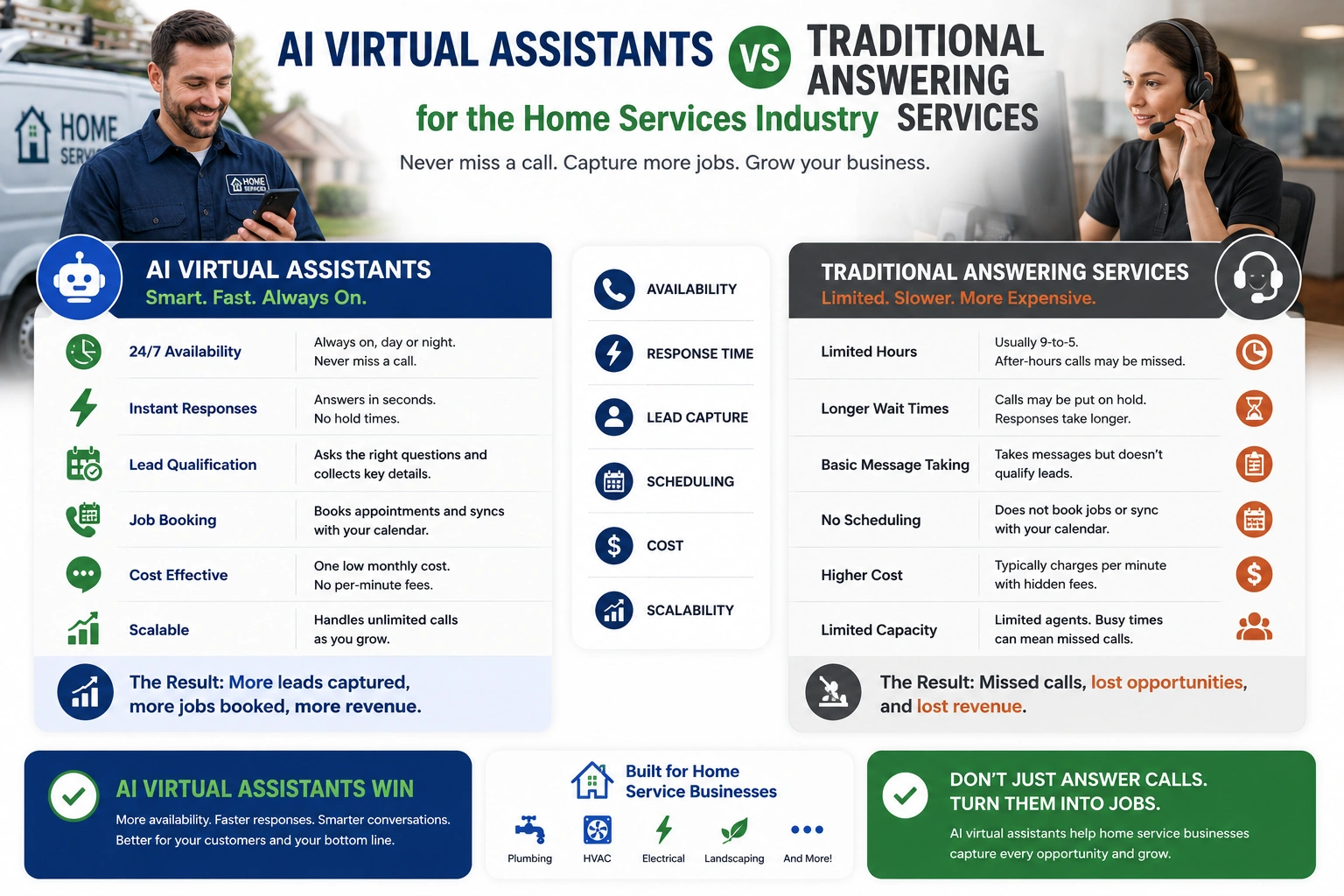
Choosing between an AI answering service and a traditional answering service can significantly impact your business. In this guide, we compare both options across cost, availability, performance, and customer experience.
AI vs traditional answering service: overview
Both AI and traditional answering services aim to ensure your calls are handled when your team is unavailable. However, how they achieve this—and the results they deliver—are very different.
Availability and response time
Traditional answering services rely on human agents working scheduled shifts. During high call volume, wait times can increase and call quality can vary.
AI answering services operate 24/7 with no wait times. Every call is answered instantly, regardless of time or volume.
- Traditional: Limited by staffing and shifts
- AI: Always available, no delays
Cost comparison
Traditional answering services typically charge per minute or per call, which can become expensive as usage increases.
AI answering services usually offer predictable monthly pricing with scalable usage.
- Traditional: Variable costs that increase with usage
- AI: Predictable pricing with scalable plans
For a detailed breakdown, see our AI answering service cost guide.
Want to see how pricing compares for your business?
Call handling consistency
Human agents vary in experience, training, and performance. This can lead to inconsistent call handling and missed information.
AI systems follow predefined workflows, ensuring every call is handled consistently and accurately.
- Traditional: Inconsistent depending on agent
- AI: Consistent, repeatable performance
Capabilities and automation
Traditional answering services primarily take messages and forward calls. Their ability to automate workflows is limited.
AI answering services can:
- Capture lead details automatically
- Book appointments directly
- Answer common questions
- Route calls intelligently
This reduces manual work and improves efficiency.
---Customer experience
Customer expectations have changed—people expect immediate responses.
Traditional services can provide a human touch, but delays and inconsistencies can negatively impact experience.
AI provides instant response and structured interactions, which often leads to faster resolution.
Which is right for your business?
The right choice depends on your priorities:
- If you prioritize human interaction at all costs → traditional may work
- If you prioritize speed, consistency, and scalability → AI is the better choice
Most modern service businesses are shifting toward AI to ensure no opportunity is missed.
If you're evaluating costs, review our pricing breakdown to understand what to expect.
---Next steps
If you're evaluating answering solutions, the best approach is to see how they perform in real scenarios.
Testing an AI system can help you understand how it handles calls, captures leads, and books appointments.
The right solution does not just answer calls—it helps convert them into real business outcomes.